|
We've all been there. The accident had been cleared off the freeway, so you suspected the cars were going a bit slower than was really necessary for safety's sake. And admit it-- as you came up along side the crumpled vehicles, you eased off the gas a bit too. It was pathetic, but never fear, here in Guyana you can learn to give in to your morbid, rubbernecking tendencies without shame or abandon. Here are some tips to get you started: 1. Re-orient your priorities. Your time (and that of the lady in the car behind you) is far less important than figuring out if that is blood or red paint. 2. Don't make any attempt to move to the side of the road as you slow down. The car behind you will be grateful for the excuse to slow down and rubberneck too. 3. Take a picture on your phone. In fact, make sure everyone in the car gets a picture on their individual phone. After each passenger gets a photo, one of them can take a picture for the driver. 4. If it's a house on fire or a really good accident, park so you can get out and take more pictures. Bonus points if your parking job obstructs traffic, giving other drivers more valuable rubbernecking time while they squeeze by. 5. If you are one of the rare people that actually wants to get by in a hurry, the best thing to do is drive down the wrong side of the street. This has the benefit of further slowing traffic to maximize accident viewing time for the on-coming traffic. 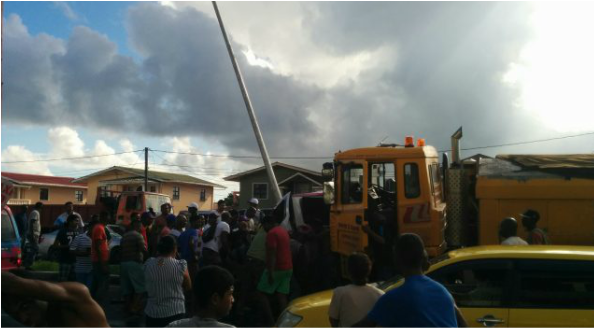 Guyanese engaging in first-rate rubbernecking at an accident we passed on Saturday. Photo not taken by me, because my skill is not yet at that level. I once taught a workshop on impact evaluation methods to staff of a non-profit. I introduced the idea of impact, defining it as the change in outcomes that can be attributed to a program or intervention. This concept is at the heart of impact evaluation, which aims to measure the difference between the outcomes we observe with our program, and what would have happened if the program weren't there. One of the participants raised her hand, and insisted that it couldn't be an impact unless it was long-term, and holistic. I answered that ideally, impact should look at both the short-term and the long-term, across many outcomes, but that for the purpose of our lecture, it was also okay to refer to the "impact" a program has on a short-term outcome. For the remainder of the lecture, whenever I referred to impact, she would mutter "long-term".
That was my first encounter with the difference between how "impact" is used by impact evaluators, and how the term is used in the traditional monitoring and evaluation (M&E) field. To get a sense of how traditional M&E folk view impact, here is the definition used by my talented colleague Dominique, who oversees monitoring and evaluation for the Ministry of Finance: "The long-term, cumulative effect of programs/interventions over time on what they ultimately aim to change, such as a change in HIV infection, AIDS-related morbidity and mortality. Note: Impacts at a population-level are rarely attributable to a single program/intervention, but a specific program/intervention may, together with other programs/interventions, contribute to impacts on a population." Notice that Dominique's definition specifically points out the difficulty in attributing impact to specific interventions. This is pretty much in direct A new organization called What Went Wrong? has started operations in Ghana. Anyone can call or tweet reports of aid projects gone awry or unfinished.
This is an exciting development, because programs like this have a great deal of potential to improve service delivery, particularly in hard-to-reach places. It's not a new idea; for example, an organization called WaterAid is working with local partners to report and map broken water pumps in Malawi. There's something about What Went Wrong? that makes me a bit uncomfortable though. Perhaps because its team appears to be photographers and visual designers, it seems to focus more on documenting an "experience" with aid, instead of making aid work better. Shaming aid behemoths like USAID or the World Bank for poor performance can be deserved and bring necessary reforms, but I'm not sure tweeting pictures of unfinished aid projects at NGOs is always the most productive way to improve delivery, especially for small local NGOs in a culture that values saving face. I can appreciate development disaster porn-- I've saved a copy of a newspaper article titled "Goats Infest Tomato Factory" for years-- but I would love to see an organization like What Went Wrong? partner more closely with organizations delivering aid, to create a link between identifying problems and providing solutions. Twice since arriving in Georgetown, I have seen a disproportionate amount of disarray caused by someone who simply appeared to be completely oblivious to how their own position was affecting others' ability to get around.
The first time was in a small grocery store. Two women and a small cart stopped in an aisle, parked their cart, and proceeded to peruse bagged nuts and candies. The problem was, this aisle was the main entry into the store. A shopper trying to enter asked several times if she could please get by before the pair notices and squeezed over to let her pass, then moved themselves back into position blocking the aisle. I watched from the checkout line as a long line of customers formed, eventually out the door, all trying to get by. The women were not rude, and when asked to move they would allow a single person to pass, but they seemed completely unaware that a major traffic cart jam could be avoided if they just moved their cart to the end of the aisle, instead of blocking the entry. The second time was in traffic. I watched a minivan back up out of a parking spot, and then stop, blocking both lanes of traffic. The minivan sat there for a full five minutes while (I can only imagine?) deciding which direction to drive. Other cars tried to leave space in all directions for the van to go where it wanted to go, but it just sat there. Meanwhile, traffic backed up through an intersection, and down three arterial roads in the center of town. In fairness, both situations were exacerbated by poor infrastructure. The aisles in the grocery store were too small for two carts to pass each other. The roads in Georgetown are narrow, and their configuration can make it easy for a blockage on one street to affect multiple intersections and roads. However, I have noticed that many people in Georgetown seem very unaware of when their physical position is hindering others. In a tight spot, people rarely automatically move to make space, although they are quite happy to on request. Every place has its own norms with regard to physical positioning. Coming from the Western United States, when I moved to the East Coast I was initially appalled by how close people would stand to me while chatting. I always run into people in London because when I encounter someone walking at me, I instinctively move to my right while they veer to their left. In Ghana, people are often forced into tight conditions on overloaded minibuses and in crowded markets, so close quarters are fine when necessary, but generally avoided when not. In Guyana, I rarely feel crowded (even minibuses tend to keep to a reasonable number of passengers), but I am surprised by how often people seem oblivious to how inconvenient their physical position is. While these norms could just be cultural, I generally tend to think there are environmental conditions that influence them. People in cities have to be tolerant of having a lot of people close by, for example. So what accounts for Guyana? One theory I have is that Guyana is fairly uncrowded, but sometimes poorly designed. As a result, people don't often get in each other's way, and aren't used to thinking about it. However, in some spaces, getting in the way suddenly becomes much more likely, and can have preposterous results. The other theory I have is that people are just used to being asked to move, and therefore don't employ the same vigilance as a socially awkward, outdoorsy girl when it comes to avoiding being in the way. This theory is supported by the norms of driving here, where anything seems to go until someone starts honking at you to move. I don't expect this to change any time soon. Guyana's population growth is near zero, and it has a long way to go in improving its infrastructure. Changes to traffic or parking arrangements often increase chaos before reducing it; when minibuses were moved out of the central market, Main Street in Georgetown was practically impassable for a week. In the meantime, maybe it's not so bad to actually communicate with strangers while moving past them on the roads or in supermarkets.
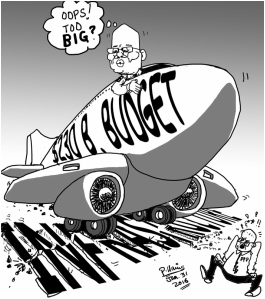
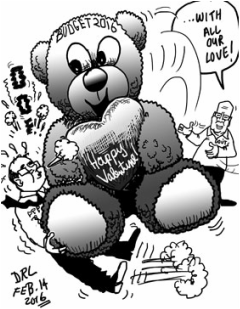
The cartoons above appeared in local newspapers after the release of the 2016 Budget. (The cracked word in the left-hand one says "infrastructure".) The $230 billion budget will result in one of the largest deficits in recent years, even assuming that revenues grow an optimistic 7.2 percent. But while Guyana's political cartoonists have focused on this, Guyana's politicians largely have not.
Most of the political discourse over the budget, both in the parliamentary debates and in the media, has focused not on the budget being too large, but on whether or not the Budget is pro-poor. Some common criticisms include: 1. The current government is just doing everything the same as the last government, and there are no new policies or programs. 2. The new policies and programs are terrible. Criticisms 1 and 2 often both show up in the same speech. 3. Not enough money is being spent on supporting rice, sugar, tourism, or other industries. As for numbers 1 and 2, let's just say that no country has a monopoly on nonsensical political rhetoric. Number 3 is more economically interesting, especially since the budget is so large. It is true that spending is focusing on infrastructure, health and education, rather than industrial policy, and this is controversial. The government recently announced it will close one of its state-owned sugar estates, a decision that will put hundreds of people out of work. However, the state-run sugar industry produces sugar at almost twice the cost of the global sugar price, and the money that goes to propping up the sugar industry is money that can't be put towards programs in health, education, or other basic government services. It might be that criticizing the budget for not having something for everyone scores more political points than criticizing its size. But it would be nice to see more of a conversation about the trade offs inherent in spending more on government programs. Guyana is a country that is very cognizant of the environmental sustainability of its policies; it should strive to be cognizant of the economic sustainability of its policies too. Several weeks ago, a bony, scrappy kitten decided it wanted to live with us and our kitten-eating dogs. When it first showed up in the yard, we put it outside our gate, only to find it back in the yard again an hour later. We put it back out on the street, but it came back again and followed Jeremy up our stairs to the front door. To prevent a kitten massacre, and because it was a pathetic but affable kitten, we took it in with the hopes that our dogs would learn to distinguish between "kitten" and "kibble".
All our attempts to teach the dogs the kitty wasn't food failed. Maybe it didn't help that we ended up calling the kitten Meatball. For his safety, we kept Meatball in a separate room, with kitty litter and bowls with water and food. He slept in Zoey's kennel. Zoey got a couple heavenly weeks sleeping in our bed. While Zoey enjoyed lounging on our pillows and cleaning up un-eaten cat food, Cody developed what can only be described as an obsession with eating the cat. He would pine away in front of the door to the cat's room for hours. I had to drag him outside for his walks. He would leave his food half-eaten (which Zoey took advantage of) in order to run back to his vigil by the cat's room. We tried to train Cody to sit with us instead of fixating on the cat. But even while we ate dinner, his attention was fixated on the cat's door. When we weren't looking, he would crawl away from us towards the door. He would freeze when we told him "no!", only to inch forward a moment later, like a game of "red light, green light". We tried holding the cat around him, to get him used to it. His obsession remained, regardless. Cody started losing weight, and Zoey was becoming agitated that her playmate no longer had interest in running around with her. Meatball was getting fed up with staying in one room alone most of the day. Jeremy and I were at our wits' end trying to care for a kitten and two dogs, one of which was neurotic and feli-cidal. We decided to look for a new home for Meatball. Luckily, our friend Jason agreed to take Meatball. With an easy-going and fun personality, we thought he would be a good fit for the boisterous little kitten. We packed Meatball's cat food and litter box into Jason's car, feeling relieved that our dogs would soon be their happy, healthy selves again. I haven't posted recently because things have been quite busy with the release of the 2016 budget for Guyana. The budget was delivered to Parliament on January 29th, and the Minister of Finance gave his budget speech on the same day. The full budget speech can be found here. For a good independent synopsis and analysis, see Ram and McRae's comments on the Budget at Stabroek News here. Don't blame me for the cover. Apparently the cover design was a big negotiation during the last budget cycle, so they decided to just copy the same design from last year. I wanted this one:  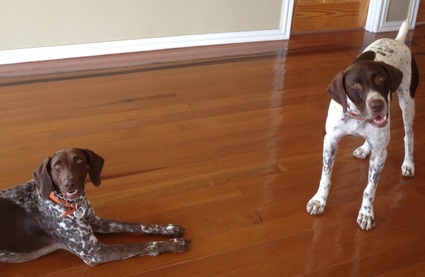 Cody has a high discount rate because eventually Zoey takes everything. Cody and Zoey love sleeping on our bed. However, we don't always love them sleeping on the bed, because Cody kicks, and Zoey insists on sleeping between me and Jeremy, making it impossible for us to cuddle. Luckily, as much as they would rather be on the bed with us, the dogs are usually willing to give up their spot on the bed and retire to their kennels in exchange for a small treat. In fact, they are more than willing. Zoey will race to a kennel at the site of a treat, sometimes a kennel Cody is already in. Rather than risk losing out on a treat, she will dive in with him, unperturbed, while Cody looks at me in panic, imagining a night crammed in his kennel with his younger, more energetic counterpart. After Zoey is hauled out and sent to her own kennel, and the dogs scarf down the chicken, cassava chip, or bit of peanut butter cookie I've scrounged from the kitchen, I wonder if my dogs are employing hyperbolic discounting when they trade their spot on the bed for a bit of food. Most people would rather have a reward now than the same reward later; we place higher value on getting the same reward sooner. This is called discounting, and it is perfectly rational. The higher the premium we place on getting things sooner, the higher our "discount rate". Economists often assume that people's discount rates are the same for waits that occur tomorrow, and waits that occur in the more distant future. For example, if I would prefer to have $100 today than $110 tomorrow, I should also prefer to have $100 in a year than $110 in a year and a day. But in real life, it often doesn't work that way. Many people would prefer to have $100 today, but they are willing to wait a day for $110 if that wait will happen a year from now. This inconsistency in the discount rate, depending on how far in the future the wait will be, is often described using a model called hyperbolic discounting. Normally, we don't think hyperbolic discounting is a great thing. It can lead to saving too little, and makes people vulnerable to scams like predatory lending. However, it is a very natural thing. It's typical among people, and has been observed in other primates, rats and pigs. (Weirdly, guppies engage in spacial discounting, choosing small food rewards over larger food rewards if the small food reward are closer, but they seem to have a linear discount function, suggesting they care more about the difference in distance when the reward is far away.) I couldn't find any papers on hyperbolic discounting in dogs. At first, I thought maybe this was because dogs just always eat their $100 treat right away, and studying a discount rate that is always infinity is utterly uninteresting. However, I was wrong: I did find a study showing that dogs will choose a smaller treat when they know they will be rewarded for it, indicating they do have some sense of delayed gratification. So when I offer Cody and Zoey a treat if they get off the bed and go to their kennels, am I the equivalent of a payday lender offering a loan for a flashy new TV at exorbitant interest rates? Do Cody and Zoey sit in their kennels, thinking that that tidbit of cheese totally wasn't worth giving up the chance to curl up by my head and fart on my face all night? It's possible they do, but I snuggle up next to Jeremy in my relatively hair-free bed, and then assuage my conscience by telling myself I will take them for a walk tomorrow. 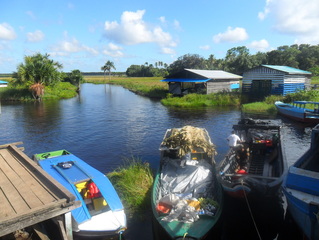 This week I went to Region 1, which is in northern Guyana, on the border with Venezuela, for a work trip. I was traveling with staff from the Ministry of Amerindian Affairs to learn more about government projects in Amerindian communities, and the barriers the communities face to development. Getting there involved a lot of traveling in little boats, like the one on the far left in the picture above. During the trip, I wanted to show the Guyanese staff that I was a seasoned traveler, who could roll with the challenges of getting around some of the least accessible regions of the country. In general, I thought I was very calm, organized, and professional. There was one moment, however, when it all came apart. We were sitting in a boat waiting to cross the Essequibo. The boat leaves when it is full, and we were still short a couple passengers. As we were waiting, another boat arrived at the little dock. The passengers unloaded, some with dainty purses, and some with heaps of baggage. One man came with a dozen stack-able trays of baby chicks. The chicks waited in their high-rise crates on the dock while other passengers unloaded and their chaperone settled his bill. As our boat rocked gently next to the dock, one of the chicks made a dash for it, jumping out of the top of the crate and landing unceremoniously on the rickety dock. That was the moment I lost my shit. "OH NO! ONE GOT AWAY! DON'T LET IT ESCAPE! IT WILL FALL IN! IT WILL FALL IN!!" It only took a second for the chick's chaperone to swoop in and scoop up the errant bit of fluff, and deposit it back with its siblings, but it was too late for me. My outburst provided quite the spectacle for my boat-mates, who all had a good good laugh. And after that I was forced to admit that my hopes of cultivating an image as a blase world traveler were truly dashed. |
About Liz
I have worked in economic policy and research in Washington, D.C. and Ghana. My husband and I recently moved to Guyana, where I am working for the Ministry of Finance. I like riding motorcycle, outdoor sports, foreign currencies, capybaras, and having opinions. Archives
December 2016
Categories
All
|
 RSS Feed
