|
Just so you all know, we expats were being ironic about racism before “hipster racism” was even a thing. If you sit down for beers with a group of expats living in Ghana, race and culture will come up sooner or later. We ironically call ourselves Salimingas. We ironically call each other out for chewing our fufu. And we ironically sing and dance to the “African Man” song, professing our need for “ a strong, black man to handle my love…” Most white people in America have the luxury of not thinking about race if they don’t want to. And let’s be honest—most don’t want to. (If you are white, test yourself: when was the last time you thought of yourself as white? Do you feel uncomfortable calling yourself white?) White people in Ghana don’t have that luxury. The way people see you and treat you reminds you that you are the “other”. In Ghana, this isn’t at all subtle. I’m pretty comfortable saying I’m white in part because small children tell me I am every day. Race is a much more present topic for white Americans in Ghana not only because we suddenly find ourselves the minority, but also because skin color and race are often talked about in frank and open ways that would be startling in the states. The other day I was at the bank with a surveyor, and he told our place in the queue of Ghanaians was “just behind that colored guy.” My first impression was to think he meant the one guy wearing bright orange robes, but the ostentatiously dressed man was nowhere near where he pointed. My next thoughts were a) wow, “colored” is an antiquated term, and b) …um aren’t all those guys colored?, which I immediately felt racist for thinking. My surveyor clarified that, like the term “fair”, “colored” referred to people with slightly lighter skin. (Side note—as in the states, skin tone among Ghanaians is not completely neutral. Use of skin lightening crèmes is extremely widespread among Ghanaian women.) 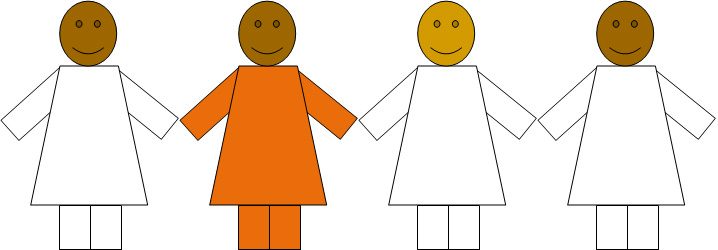
Wait, WHICH one is the "colored guy"?
Being able to talk and joke about being white in Ghana is an important mechanism for coping with it. When small children climb out of the sewer and reach out and touch you, you can get annoyed that your skin color makes you a petting zoo object for kids that just climbed out of a sewer, or you can laugh and ask them if white skin feels any different than black skin. When people yell “white man” at you, you can quietly seethe, or yell “black man!” back. When a taxi driver quotes you a price three times the market rate, you can get angry, or you can pull out your most dramatic Dagbani accent and yell “oh, aba!!” (why, or wtf!?) When that driver later tells you he wants to marry “a white”, you can get annoyed or tell him your other husbands wouldn’t like you to marry again.
Is this bad? In the states, “hipster racism”—making stereotypical statements about race with the implication that it’s okay because you aren’t actually racist—has been roundly condemned in the blogosphere. The logical fallacy here is one that might be ascribed to hispterism in general: you may be drinking PBR ironically, but you are still drinking PBR. You may be saying racist things ironically, but you are still saying racist things. Either way, you are contributing to the proliferation of the object of your irony. PBR won’t go off the market just because you were being ironic when you drank it, and stereotypes won’t go away just because you are being ironic when you voice them. Hipster racism naively—and wrongly—assumes that racial stereotypes no longer have the power to harm. This doesn’t mean that all racially- or culturally-based humor need be taboo. Such humor can be effective at addressing problems that otherwise might be difficult to talk about. And let’s be honest—when the Ghanaian dancers at AllianceFrancais dress up in white face and chase women with comically inflated butts, it’s actually kind of funny. In determining what humor is harmful, here are some things I think should be considered: 1. Whether the humor perpetuates the stereotype or challenges it. Humor can be a powerful tool for bringing up stereotypes and revealing their absurdity. Teasing a child about touching you, or calling someone “black man”, can humanize you and make the person think about what he or she just said or did. 2. The connotations of the stereotype. Somehow I doubt white people in Ghana will suffer much if they have a reputation for chewing their fufu. Stereotypes about groups being lazy, or uneducated, or mean, etc., have a lot more potential to harm. 3. Whether the group targeted disadvantaged. The truth that a lot of white Americans may not realize, or may be uncomfortable with, is that power matters. Racial stereotypes have a lot more power to damage when they come from a privileged majority than an underprivileged minority. That is not to say that minorities get a free pass—I have been personally hurt by racism directed at me by members of a minority race in America—but the stereotypes held by these groups have never prevented me from getting a good education or good job, or having access to goods and services. The power of negative stereotypes rings hollow for groups that have the advantage of power and privilege. Members of privileged majorities have a greater responsibility not to be nonchalant about the impact of the stereotypes they throw around. 4. Whether the group targeted is you. Laughing at yourself is generally braver, more therapeutic, and less likely to cause harm than laughing at others. Targeting your own demographic isn’t a blanket pass, though. You should be aware that your comments reflect on others of your group. I was once horribly disgusted by some comments a black American made to me about his race. I later wish I had asked him if he would be comfortable with someone referring to his mother, or sister that way. That’s a good rule: if you wouldn’t find the joke harmless and funny if directed at someone you care about, it’s not funny if directed at yourself. Next, you should be aware of what a statement about your own group might imply about other groups. For example, if I say that if Americans who had to wait two hours in line at GCB would riot, I am also making a statement about Ghanaian’s willingness to do the same. In general, I think that race and racism should be talked about a lot more everywhere. But an important corollary is that when it comes to those issues, people need to listen and think a lot more too. I’ve heard Ghanaians insist with absolute certainty that white people aren’t charged higher prices in Ghana. Similarly, I bet there are a lot of people who aren’t aware of the extent to which racism affects minorities in America on a daily basis. For instance, there are still plenty of businesses where black patrons aren’t welcome. I once posited that it is harder to be black in America than white in Ghana. A friend of mine (also white) thought the opposite. The point is, racism is hard on everyone. Humor related to racism should be a tool to ease that burden, not increase it.
9 Comments
atta
6/5/2013 08:28:55 am
what she's sayin is contrary to de attitude of ghanaian, only dat kids will make mockery of ur colour by callin u "obroni" which means white person all becos de colour baffles dem bt whn they grow they will understnd is normal. as for cab drivers nt all of em, they might try to take advantage to dupe u all becos they think u are allien..nobody is a racist
sister....
10/6/2013 08:47:31 pm
I'm also a white person in Ghana and suffer from racism every week. It's not just kids who like to touch, but also those who are very adults. They like to grab and pull you and attach you... they like to shout all sorts of insults.. and laugh at you. They're mostly ladies. 9/30/2013 09:49:39 pm
This is a wonderful article, Given so much info in it, These type of articles keeps the users interest in the website. 1/9/2014 03:09:11 pm
In truth well-off content and exceptionally constructive information. I got it my resolution from over here. I exceedingly propose his/her moving parts with the constructive edifying information. Thanks a lot……….. 1/27/2014 02:05:07 am
I am so happy to read this. This is very educational content. Really this is breathtaking effort with the blog. . I wanted to thank you for this great article. Thanks for this excellent information.
Michael
10/2/2015 11:56:38 pm
In Ghana we don't deal with race but allien and its mostly of kids because they haven't see a white person before. I don't deny that they insult u like calling white person "toy" because they are inactive which they like to play with and "animal" because u chew leaves. They will also laugh at u because u mostly look sooooooooo skinny and which goes to me too calling me "Wiz Khalifa" cause i look very skinny as him "lol" and with small tits. Leave a Reply. |
About Liz
I have worked in economic policy and research in Washington, D.C. and Ghana. My husband and I recently moved to Guyana, where I am working for the Ministry of Finance. I like riding motorcycle, outdoor sports, foreign currencies, capybaras, and having opinions. Archives
December 2016
Categories
All
|
 RSS Feed
