|
Eliot Spitzer writes that the state of American men's tennis is a metaphor for the state of the U.S. economy. The article isn't well executed-- he makes a detour into causation vs. correlation just to take a dig at deficit hawks. (Maybe we wouldn't have a demand problem now if we hadn't been spending beyond our means for years and years??) His final point is somewhat valid though-- America is less dominant in tennis and in the world economy because other nations have made gains, and the competition is stiffer, and that's a good thing.
What I take from this is that it is no longer the default that white American men will stay on top. (Spitzer glaringly fails to analyze the state of American women's tennis.) Neither a Grand Slam trophy, nor a big screen TV and two cars, are the inherent right of an American man. Like everyone else in the world, if we want to succeed, we need to make ourselves competitive.
0 Comments
In Kusa, a mosquito bednet is called a "doomsdog". The literal translation is "mosquito room". The words in several other Northern Ghanaian languages are similar, translating to "mosquito room" or "mosquito house".
Apparently, this terminology can lead to some confusion. I recently heard a story about a farmer in a net distribution program. He was visited by a program officer conducting random checks to see if the net was in use. When the program officer arrived, he found the net hanging outside, and the man sleeping in his house, netless. When he asked the farmer for an explanation, the farmer gruffly responded: "Ahcht! These stupid salimingas don't know anything. I hung the net and all the mosquitoes still come to me. The mosquitoes don't go to their room at all!!" 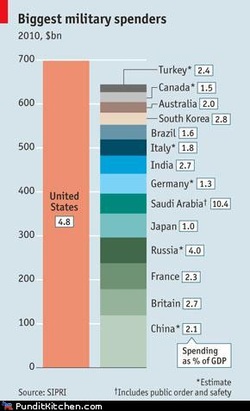 Military spending by the top military spenders, from the Economist. What if we replace military spending with official development assistance for these same countries? 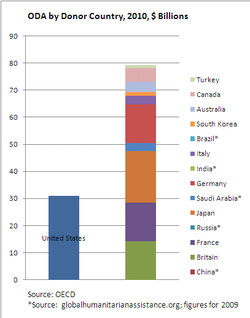 I am now writing to you from beautiful Brong Ahafo, where the cars are strong, the chameleons are good looking, and all the roads are above average.
Sadly, though the cars are strong, there is a shortage of shared taxis here unlike any I have encountered anywhere in Ghana. (Shared taxis run routes, and pick up anyone who wants to go on that route. Most of the time, they are a convenient and inexpensive means of transport.) Getting a shared taxi in Sunyani involves standing at a corner and yelling where you want to go as taxis go by, and then when one stops, rushing to beat the hoards all going for that taxi. The first time I was there, I got a taxi because a driver felt sorry for the poor clueless white girl and made it a point to get me in his car. The next time, I got a taxi based on my rushing merit, which was infinitely more satisfying. Why don't more people run taxis here? Why don't they raise the price of taxis? I later discovered that the taxi shortage was being caused by a diesel shortage. Many of the taxis converted to run on diesel were not running. Yet again, things that appear to make no sense to an American economist have a logical explanation. The diesel shortage was temporary; sticky prices and fixed capital costs prevented the market from clearing. Given the shortage, what is the appropriate way to allocate taxis? Free marketers might suggest they be allocated to those willing to pay the most. However, if your concern is allocating them to those who have the most need for them, and you think the welfare created by this outweighs the extra supplier surplus that would go to the taxi drivers, there are other ways of allocating them, which might be more efficient in a context of high income inequality. One, the use of lines, would allocate taxis to the people most willing to spend their time waiting for the taxi. Another, the one actually in use, is to make people spend effort. Those most willing to run, fight, and look foolish must be the ones who value the taxi service the most. About 10% of the cloths I brought to Ghana go unworn. There’s the long, patterned skirt that I thought would be perfect for a hot climate where women don’t show their legs, but whose synthetic fabric catches uncomfortably on sweaty skin. There is the cool-looking white blouse that turns see-throw when it gets wet in sudden rainstorms. There is the sharp, sexy pencil skirt that is physically impossible to ride on a motorcycle in.
Knowing what to bring, and when to wear it, can be a challenge in my work. You have to be prepared for everything from meetings with government officials to dusty trips to the field, in weather that ranges from swelteringly hot to cool and dumping buckets of water. In every case, you have to consider cultural norms that are not your own. For armies of interns about to pack their bags and head off to get their toes wet (and dirty, and sweaty, and mosquito bitten) in West Africa, here are my tips for dressing for development work: DO focus on material for comfort. No matter what you are doing and where you are going, it will be hot. Look for very lightweight, natural materials (like linen or cotton) to stay comfortable. I favor light, knit shirts that fit neatly and have some embellishment that brings their formality up a notch. DO focus on cut for appearance. Comfortable materials can be cut to look professional. Men should look for very light weight collared shirts and slacks. Light-weight khaki pants with a sharp cut can go from office meetings to the field. DON’T bring stuff that can’t get wet. Between sweat and monsoons, it will. DON’T bring stuff you love. Handwashing is rough on cloths. So is falling in sewers, being grabbed by random children, getting bitten by goats, and being lashed by wind and rain. If it will break your heart if it gets ruined, leave it at home. DON’T bring white stuff. It will get dirty super fast. Khaki, brown, red, green, black or dark blue are much more field friendly. DO bring jeans. They are an awful fit for the climate, but everyone wears them, and you probably will too. DO wear a hat, sunglasses, and sunscreen. DON’T wear shorts while working. Shorts are rarely worn in Ghana, and never in the workplace. Very short shorts will always draw attention. Short sleeves are fine; nice sleeveless shirts are usually okay. DO wear skirts, if you are a lady. Skirts are a great way to keep cool while looking nice; they are the loophole in the “no shorts” rule. Just keep them around knee level or below, and unless you are adept at riding side saddle, don’t wear tight skirts if you are planning to ride moto. DON’T forget to bring fun clothes—outfits for working out, clubbing, dates, hanging around the house, or trips to the beach. And don’t forget a swimsuit! DO wear nice sandals. If you are a man, look for nice local-made leather sandals that can be worn with your lightweight khaki trousers. Ladies can wear any nice looking sandal. DON’T wear heels, except on carefully considered occasions, but DO bring a pair. The ground is very rough here, and you will walk, so find nice-looking shoes that are comfortable. Also, it is very hard to drive a motorcycle in heels. Some clubs require ladies to wear heels to get in, so come prepared for that. DON’T wear “bathroom shoes”. Bathroom shoes are inexpensive flip-flops that Ghanaians wear to go to the bathroom. If you can’t tell the difference between bathroom shoes and potentially work-appropriate flip-flops, don’t wear flip-flops at all. IPA Ghana officially does not allow flip-flops in the Accra or Tamale offices. DO get something made locally. The tailors in Ghana are talented and inexpensive. DO ask a local friend or coworker if your clothing is appropriate. This is especially true if you are attending an unusual function, like a funeral, or if you are experimenting with local fashions. DO consider the impact of your appearance. Ghanaians are often inappropriately forward with ex-pats in a way that they would not be with a fellow Ghanaian; this is especially true for women. Consider whether your appearance will encourage people to treat you as a professional; clothing that is too casual or sexy will encourage advances. It’s no fun to be shooing off suitors while walking into a partner meeting. DO break at least one of these rules. Putting on that one dress you really love, or wearing shorts to the market, or (gasp!) wearing a pretty pair of flip flips to the office can be a fun, harmlessly subversive way to escape from the constant pressure of fitting in to another culture. Chris Blattman’s blog recently critiqued an article by Dan Pallotta arguing that earmarking funds for programs with proven impact is actually less impactful than using the money for further fund-raising efforts. Pallotta makes an argument that spending on fund-raising allows you to, in essence, leverage your funds and get a much higher return on investment than you would if you’d spent that money directly on programs.
Blattman makes two counter points: 1. The effectiveness of the programs you are funding feeds back into your ability to use your money to raise more funds. 2. It’s not clear that lack of funds is the binding constraint in aid. I’m a bit skeptical of Blattman’s second point—I thought I was out here getting malaria to make sure that scarce development resources were spent on programs with the highest impact. I think it is more correct to think of funds and good practice as being similar to labor and capital—in most circumstances you can add more of one or the other and improve outcomes, but are most effective when increased together. I think Blattman’s first point is completely correct. Pallotta is right that fund-raising can increase impact, but program impact is fundamental to fund-raising effectiveness and meaning. Donors should be attracted by good programs. In a rational world with perfect information, donors would know exactly how much money they wanted to spend, and they would choose the program with the highest impact-per-dollar. This is how these institutional funders Pallotta is complaining about behave. However, in the real world, human behavior is less rational and more suggestible. If fund-raising can actually increase the number of dollars out there to be used on development, it can indeed be highly impactful. Note that fund-raising that just diverts funding from one project to another from a fixed pool of resources doesn’t get to claim this—unless the program it diverts money to is more impactful that the program it diverts money from. Which brings us to the next point-- if your programs don’t have impact, it doesn’t matter how much you leverage your dollars- you are just using more money badly. Palotta’s proposal to use seed money to fundraise is similar to the concept of hedge funds. Hedge funds can’t make huge returns without leveraging their initial funds with loans, but if they don’t put the leveraged funds in investments with good returns, they are just wasting everyone’s money. Palotta also argues that you often can’t know what is going to be impactful ex ante. That may be true, but that doesn’t mean you should throw in the towel and give up on trying to target impactful programs. Market investors often can’t know which stocks will take off, but no investor would throw money at one without trying to make an educated assessment of its future value. If funding truly is a scarce resource, you have to have some standard for choosing which programs to fund and which not to. Polatta may be right to encourage donors to allow their funds to be used for further fundraising, but this only makes sense in concert with an emphasis on evaluation. After all, what is the point of all that fundraising if you aren’t going to do anything good with it? And for fundraising to matter, Blattman must be wrong about money not being a binding constraint. If money is a binding constraint, then you can’t fund everything, and it becomes all the more crucial to have some way of assessing the best programs. The project manager on my project is now assisting with a village savings and loan project, and told me some interesting things about working in Bawku, a region in Ghana where violence has broken out between two tribes, the Mamprusis and the Kussassis.
According to my colleague (a Ghanaian), in the first century, the Kussassis, who were traditionally farmers but not fighters, asked the Mamprusis, who were known as warriors, to come to move to their land. In exchange for protecting the area, so the Kussassis could farm in peace, the Mamprusis were given the chieftaincy in the region. The agreement has held for centuries, and in Ghana’s system of parallel democratic and traditional governments, the Mamprusis still hold the chieftaincy, although they are far outnumbered by the Kussassis. The democratically elected official for the region is Kussassi. Several years ago, the Kussassis became unhappy with this arrangement, demanding the return of a Kussassi chief. Violence broke out between the tribes. Despite interventions by the central government, including curfews and prosecution of those perpetrating violence, the situation has remained tense. The Mamprusis control Bawku’s city center while the Kussassis control the surrounding land and villages, and members of the two tribes cannot safely visit the other’s territory, although visitors from other tribes or countries are safe. This situation has posed difficulties for the IPA survey team in the region, as they are trying to collect data in both tribes’ territories. It is crucial that surveyors be hired locally, so they have knowledge of the area, culture, and languages. Since young men on motorcycles have been responsible for much of the violence, the Ghanaian government has recently banned all men in the region from traveling on motorcycles --the chief form of transportation for IPA surveyors. Enter the ladies. IPA surveyors are overwhelmingly male, as it can be difficult to find women with top educational qualifications and a willingness to take on the physically demanding work. In Bawku, the project manager was successful in finding half a dozen qualified women with motorcycles to fill out the ranks of IPA surveyors in the region. Women are not subject to the ban, and can legally ride motorcycles to visit respondents. The team includes women of both ethnic groups, to enable IPA to work in both territories and with respondents of both tribes. The field manager, who will oversee the survey team in that region, is a women of mixed descent, half Mamprusi and half Kussassi, and can safely work in either tribe’s territory. I wish the team the best, and hope that they will demonstrate both the ability of women to be exceptional surveyors and the possibility that people of these two tribes can work together toward common goals. Donald Marron recently bloggedabout a new economics paper on gender arbitrage by multinationals in South Korea. The idea behind gender arbitrage is that discrimination in hiring against a particular group, like women or minorities, creates opportunities for non-discriminating employers to hire talented people for a lower wage. When non-discriminating employers take advantage of this, it should eventually erase the gap in wages between the disadvantaged group and the rest of the labor market. This paper found that multinational corporations have been able to benefit from discrimination against women in the labor market that drives down wages for educated women. In Korea, working women earn only 63% of what working men do. (Not all of this is due to discrimination.) The paper found that among multinationals, a 10 percentage point increase in the number of women in local management positions led to a 1 percentage point increase in return on assets. Marron points out that the fact that companies that hire more women have a hire profit margin means that there is still room for more arbitrage-- implying that discrimination is still resulting in lower wages for women compared with men who have the same skills and abilities.
As unfortunate as it is that women in Korea are being paid less than they are worth, from the perspective of both women and employers in northern Ghana, this is an enviable problem. In Ghana as a whole, about 20% of adult males have secondary education or higher; only about 10% of adult females have that level of educational attainment (source: GLSS 5), and the gender gap is most pronounced in the Northern Region. Traditional views of gender roles still prevent girls from having access to education at the same rate as boys. (Girls may also have a higher opportunity cost of education: girls are often more economically valuable than boys, because they can assist with child-rearing and food processing, or work as maids, at an age where boys are still too young to be much help with farm work.) The result of this is that it is difficult to find qualified female candidates for jobs requiring a high level of education. This is especially apparent to employers like me, who actually have a bias in favor of female employees. Since the majority of the respondents in my survey were female, I wanted to hire female surveyors because they are more likely to put female respondents at ease. Despite actively recruiting female candidates, posting notices encouraging women to apply, and asking the field managers to try to achieve a balance in the number of male and female surveyors we hired, we received few applications from female candidates, and less than a quarter of the surveyors we hired ended up being female.  I've spent 36 hours on Ghanaian bus trips in the past month, much of it watching Nigerian ("Nollywood") movies. The Cinderella story is a common theme in many of these movies: a poor village girl, or sweet middle-class modern city girl, meets a young African prince, who buys her lots of stuff, defends her from his disapproving parents, and takes her away to live in a palace.
I had an interesting conversation about women, love and money with several male Ghanaian colleagues the other day. All three of them agreed that women, in general, loved men for their money. One of them said that he was glad he married his wife My male American colleague gallantly came to the defense of my gender, and contended that while this might be true for some, it was untrue for most, and it was impossible to "love" anyone for their money anyway. One coworker suggested that American women were less likely to love a man for his money than Ghanaian women. With Nigerian Cinderella fresh in my mind, wasn't so quick to dismiss the attraction of money, but instead asked what was wrong with that? What we find attractive is influenced by our needs, and what society admires. Marriage has long been an economic union, and ability to provide economically has been necessary to that union, and socially admirable. And it is no more shallow than many of our other criteria for love-- which is a more accurate reflection of character, the looks a person was born with, or the money they earned? (We will put aside the money a person was born with for the moment.) The major difference between West African women and American women is that for West African women, economic survival is much less assured-- and hence a greater need. If the Cinderella fantasy still limps through American culture, it should be unsurprising to find it prevalent in West Africa, where many women do not have the luxury of discounting their mate's ability to provide economically. If men want women to marry them for attributes other than money, they should do all they can to empower women to provide for themselves, so they will have that freedom. Also, they should consider their decisions to have multiple wives and mistresses. When being able to provide for multiple women becomes a mark of status, it only reinforces the link between money and relationships. Treat women like people, not objects, and they will treat you as people, not meal tickets. Today I spoke with a woman who said she did not have health insurance because she had family members who would pay for her treatment if she got sick, but those same family members would not pay for her insurance premium. Unfortunately for the national insurance scheme, this sounds perfectly rational to me (at least from her perspective; not the family members').
Another unfortunately rational decision: not re-enrolling each year. The way the scheme is implemented now, if you enroll once, but fail to re-enroll the next year, you get coverage immediately at any time by just paying the premiums you have missed. Many people only re-enroll when they are sick, and the treatment cost is more than the missed premiums. This makes perfect sense, so why would anyone do otherwise? As long as people can do this, this poses a problem for the sustainability of the scheme-- if the only people who are enrolling and paying premiums are the people who are getting sick, the scheme will never be able to finance itself. |
About Liz
I have worked in economic policy and research in Washington, D.C. and Ghana. My husband and I recently moved to Guyana, where I am working for the Ministry of Finance. I like riding motorcycle, outdoor sports, foreign currencies, capybaras, and having opinions. Archives
December 2016
Categories
All
|
 RSS Feed
