|
A 20-year-old recently became internet famous for punching a man who joked about raping a drunk girl on the street one night. When is it ethical--and more importantly, efficient-- for individuals to take justice into their own hands? This question is particularly salient in Ghana, where vigilante justice is a common response to crime, and that justics goes up to and includes death for perpetrators of rape or severe property crime. 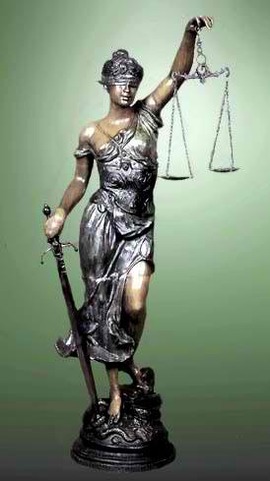 Actually, I did see what you did there. And I have a machete. Justice generally serves two economic purposes: to make an injured party whole, and to provide a disincentive against bad behavior. Vigilante justice tends to be focused on the latter. If you doubt this, just wait for the next Batman movie-- I guarantee my dear Bruce Wayne will wreak more economic havoc as the caped crusader than he will provide in redress. Vigilante justice comes at a high price, to the executioner, society, and to innocent parties who fall mistakenly fall victim to it, and is limited in the benefits it can provide.
In order to be justified then, vigilante justice must have a very high deterrent benefit. This will generally only be the case when legal justice systems completely fail to act as deterrents to morally reprehensible acts. It seems to me that the woman's decision to punch the rape joker fits this criteria. No court in the United States would ever provide any kind of consequence for comments like this man made. To me, the welfare gain from the chilling effect (amplified by publicity) this will have on such jokes, which quickly turn a fun night out into a stomah-clenching affair that can haunt a woman for months (if not years), clearly outweigh one guy having a sore nose for a couple weeks. Similarly, in Ghana, legal remedies are a poor deterrent to crime. (Especially legal remedies that are actually legal, NOT including police beating suspsects.) Even in clear cases where suspects are caught red-handed with eyewitnesses present, criminals often walk free. Two friends of mine were beaten with bricks a couple years ago, and one of the assailants was captured at the scene of the crime, but was released after several months of courtroom circus. Death by beating, however horrific, not only provides a clear disincentive to crime but permanently removes a criminal from society. So can vigilante justice be morally and efficiently right? Yes. Does that mean it should go unpunished? No. The fact that vigilante justice can have a high cost for falsely accused victims means that executioners must have a disincentive to engage in vigilante justice unless they are sure of its benefitcs. Punishing, or potentially punishing, perpetrators of vigilante justice provides that disincentive. So the woman who punched the joker should be potentially liable for damages, and those who engage in mob justice beyond that necessary for defense should be liable under assault laws, to prevent vigilantes from risking targeting those not truly guilty. This may seem like a rather extreme position; it is certainly influenced by living in situations where law enforcement seems ineffectual. However, the truth is, society engages in vigilante justice all the time. In the U.S., however, it is usually psychological, not physical: when someone cuts in line, they are often shamed, but not punched. Vigilante justice is an appropriate response to those inevitable situations where the law has no reach, but how it is exercised must be limited by disincentives against its most extreme forms.
7 Comments
Why fix it when you can make money off it?
The traffic light at the main intersection in Tamale is currently broken, at least for some directions. The police were there yesterday. Rather than directing traffic, they were arresting and extorting money from motorists who entered the intersection at the wrong time. The broken light appears to be a boon to the police. My guess is it will be a while before it gets fixed. For Easter weekend, I planned to drive my motorcycle to Ouagadougou from Tamale. It’s not a particularly long drive, perhaps 6 hours (my record is 10 hours on the road.) My plans were thwarted at the border, where I learned that to take the moto into Burkina, I needed the deed in order to prove that it wasn’t stolen. I had deliberately left the deed in Tamale to make sure I wouldn’t lose it.
The good news is that Burkina customs and border control officials never implied that I could get the moto in with a bribe. This was even more surprising, because I asked if I could bring it by paying for a license in Burkina, which, in retrospect, would have signaled that I was willing to pay a decent amount to get it in. I ended up leaving the motorcycle with the Ghana border control, who refused even a modest dash as a thank you. (I later heard a possible explanation for why the Ghana border police refused my dash—it was small peanuts to them. Allegedly, to get a post as a border patrol officer, you have to pay someone a dash on the order of GHC 1,500—but an official can make that much in a week from bribes from traders who want to avoid the even more onerous Ghana import taxes. Compared with that kind of money, a GHC 10 dash is worth forgoing in exchange for someone’s good opinion. ) I asked about leaving the moto with the Burkina border control. The officials there declined to keep it. However, the border head official tried to console me, saying, “Mais ca va—je veut dormir avec vous!” In English: “It’s okay—I want to sleep with you!” When I rolled into Tamale after 12 hours on the road, my thoughts were focused on important priorities: should I bring vodka or wine for my hosts? I pulled into Quality First to make my purchase, cutting through the pedestrian and bike zone into the parking area, per normal Tamale traffic conventions.
Immediately, a police officer converged on me and pulled my keys from the ignition, yelling at me for driving in the bike lane. He then ran off to grab keys from two other motos--like I said, I was following Tamale traffic conventions. Most official traffic laws are never enforced in Tamale. Residents are left to develop their own traffic code that allows everyone to move around efficiently and mostly safely. However, every few months the police pick a rule to enforce. Wearing helmets is a common one. All of a sudden, riders who haven't worn a helmet for a year will find themselves dragged into side streets, paying one or two cedis to a police officer to avoid going to the police station and getting cited for riding helmetless. The enforcement is not to actually get people to follow the rule-- it's an opportunity for the police to supplement their income. That's why enforcement is sporadic, and the rules enforced constantly changing: if people actually started following them, the money-making opportunity would be gone. (I actually love it when they do the helmet law, as all the survey staff suddenly comply with our mandatory helmet rule.) Three police officers rounded up three of us bike-lane offenders, to take us "to the station". Of course, they actually took us to a back alley. Two of the officers seemed like good-natured guys who would be happy for a quick cedi. One of them pushed my bike to the alley; his struggle to handle the extra weight and higher center of gravity caused by my bags detracted from any intimidating aire he might have had. The third officer had fake Oakley sunglasses on, despite the fading sun, and was clearly on a power trip. I decided I wasn't playing. "You were driving in the bike lane. We are taking you to the station", they told me. "Sorry," I said, "I didn't know." Of course I knew. Everyone knows; nobody follows it. But it's just what you say. It's what I say next that deviates from the normal script. "You are right. I did it wrong. So let's go to the station. You bring the moto." We all know that if I go to the station, they get nothing, except maybe some extra paperwork. Plus, somewhere up the chain, someone is going to think it's ridiculous that they brought a white girl to the station for driving 10 feet in a bike lane to get to a parking spot. I admit I am a bit curious about what the fall out might be if I spend a night in jail for this. Also, the officer pushing my moto looks like he might faint. The station's not that close. The third officer confers with officer Oakley in Dagbani. "We want to give you consideration," he says. "Where are you coming from?" "Kwame Danso," I reply casually. It's actually an impressive answer; very few Ghanaians would ride so far in a day. Except maybe highway robbers. "Okay. We want to give you consideration because you are coming from Kwame Danso." I'm pretty sure I could have gotten consideration for coming from Hands of Love drinking spot. I leave more cynical, but with all of my cedis still on my person. Last night, I was traveling by trotro from Kintampo to Tamale. We stopped at a police check point.
"Driver, close your boot!" I saw them pack the boot (what they call the trunk here). There's no way the boot is closing. Damn. That means I have to flirt with the other officer, who is yelling "My wife! My wife!" at me. I ask his name and tell him that I have to go to Tamale, and the faster we go the faster I can come back and marry him. We are waved on our way, along with our still-unclosed boot. When people think about corruption, they often think about it in terms of money. If your boot can't close, you pay a small dash so the officer will let you continue your journey. If you want a driver's license, you pay a dash to get it done in one day rather than three. If you overstay the 60 day limit on your visa, you pay a dash to avoid a renewal process that is very costly in terms of time and effort. But there is another currency that those who extort bribes will often accept: flattery and flirtation. I have never paid money to police at a checkpoint, but I have paid in smiles, jokes, and fake email addresses. Is this a good thing? I'm not sure. At its best, it feels like nothing more than being friendly, and the person you are interacting with can go from being a hurdle to a helper. At its worst, deferring to or faking interest in someone who is clearly on a power trip feels degrading. An interaction like the one with the trotro leaves me feeling like I have prostituted myself in small way, and more than I hate that authority figures have the power to extort money, I hate that they have the power to extort me as a sexual or romantic object, even if only in very small ways. My conclusion is that corruption is not about money, it is about power. You can reduce the bribes paid to zero, and still have corruption. That means that focusing on punishing people for taking bribes won't solve the problem-- graft will be paid in other currencies, such as favors. Fixing corruption is about limiting the discretion of individuals--setting up systems with clear rules and expectations-- to take away their ability to extort anything, be it money or my Facebook name.  The pangolin, one of my favorite animals, recently made the news. This unusual looking anteater is being hunted to extinction due to demand for its meat and scales, which are believed to, among other things, enhance sexual prowess in traditional Asian medicine. Enforcement efforts have not been able to put a stop to the trade. Although trade in these products must continue to be illegal, and these laws must be enforced, they will not be sufficient to stem this problem. Here’s why: · Lesson from the drug war: fighting supply doesn’t work with products that have inelastic demand. When demand is not very price sensitive, limiting supply just causes the price of the product to rise, giving more incentive for people to keep supplying. Endangered species products for use in medicine likely fall into this category, as likely perceive these medical cures as a need. According to the article, an entire dead pangolin used to be valued at $5; today the scales alone go for $250. Powdered rhino horn can be more valuable by weight than gold or cocaine. That’s a pretty big incentive to break the law. · Economic conditions will continue to enable higher prices and more demand. Rising incomes in China and South East Asia, the source of much of the demand for endangered species products, will further accommodate higher prices for these products. · Creating efficient disincentives in the source countries is difficult. When deciding whether to break a law, economic actors compare the benefit of the crime with the penalty, weighted by the likelihood they will get caught. In poor countries, the resources available for enforcement are limited, so likelihood of getting caught can be low. Higher prices, driven by the previous two factors, can entice more sophisticated suppliers to enter the market, who are better at evading enforcement efforts. In cases where suppliers are poor, penalties such as fines may be ineffective, because the supplier has little to lose. · Endangered species parts might be non-normal goods—meaning that higher prices actually raise demand. In the case of medicines, a higher priced medicine might create a larger placebo effect, for the same reason people who know the price of an expensive wine tend to rate its taste more highly. In the case of luxury goods, the scarcity of the product, and fact that it is illicit, might actually increase the prestige associated with owning it. These factors imply that to put a real stop to endangered species products trade, we must address the demand side. There are a couple potential approaches:
1. Try to shift the demand curve left. This involves decreasing the number of people demanding the product, or decreasing the amount of product that each person demands. In order to do this, you have to convince people that they don’t need these products, or that they are inferior to other options. Intense education, shame campaigns, and social pressure to embrace modern medicines might be approaches to achieving this. 2. Make demand more elastic by increasing substitutes. If you cannot convince people they don’t need these products, you might still be able to make demand more price sensitive if you can convince them that other substitutes can suffice. Endangered species parts might be replaced with parts from more common animals in traditional medicine recipes. This might be achieved by working with practitioners of traditional medicine to promote recipes that don’t include endangered species parts. This strategy, however, runs the risk of transferring the over-demand to other species. Any strategy aimed at demand is incredibly daunting, as it involves changing long-held cultural beliefs and behaviors, practiced even among the highly educated. And some traditional medicines work: ma huang, traditionally used to treat colds, contains pseudoephedrine, the active ingredient in many over-the-counter cold medicines, and Artemisia, another traditional medicine, is now a standard component in most malaria treatments. It is not easy to convince people that while their age-old belief that Artemisia cures malaria is true, their age-old belief that anything remotely phallic increases sexual prowess isn’t. Though if you think a pangolin looks phallic, you are probably long overdue for an STD screening. I am now the holder of an official Ghanaian motorcycle driver’s license. I feel like a bit of my inner (or not so inner?) rebel has been lost, but as consolation, I ended up paying no more than the official 34 GHC fee and a 1 GHC dash to get it, so I feel like I am still pretty bad-ass.
Corruption at the Driver and Vehicle Licensing Authority in Accra is brilliantly orchestrated. Applicants never pay a bribe directly to an official. When applicants come into the office, officials direct them to a handler. The handler, who is in no way officially associated with the DVLA, helps the applicant through the process—he assists with getting passport photos, filling out paperwork, and sending the applicant to the correct offices. The handler knows the process in and out, and has friends in the various offices. The handler keeps the process as opaque as possible, often meeting with officials without the applicant present. The handler makes it a point to pay the applicant’s fees without the applicant present, hiding the true cost of the license fee. The handler then asks the applicant for a sum larger than the true cost. If asked about the discrepancy, the handler will say that the extra is needed to dash the DVLA officials so that they will process the application the same day. Presumably, the extra is actually split between the handler and the DVLA officials. The beauty of this system is that no one can ever be caught for corruption. If an applicant complains, the only person who has ever asked them for extra is the handler, who is not affiliated with the DVLA and is just taking a fee for helping the applicant with the process. The handlers will never complain about the DVLA officials, because they make their whole living off the system. So how did I get off with a 1 GHC dash? I was smart, but I also got lucky. Before going in, I asked around about the cost of a moto license, so I knew it would be in the range of 30-40 GHC. Then I got assigned a handler who far overplayed his hand—he asked for 200 GHC to cover the cost of the license—lucky. I got lucky again when I said the price should be “30 to 40 Ghana”, and he thought I said “34 Ghana”—which turned out to be the exact price of the license. At that point, he pulled me aside, and admitted that the license cost 34 Ghana, but said I would need to pay extra to dash the officials to get the license that day. It’s possible that he may have actually slowed down the process on purpose; we hopped around to a lot of offices. I decided to call his bluff. I started loudly talking about how I wanted a receipt for everything, and how I couldn’t trust him, because he had just tried to tell me it cost 200 GHC for a license. Exclamations and tongue clicks—Ghanaian sounds of disapproval – began emanating from the crowd around us. One woman poked the handler, asked “200 Ghana? For a license?!” and shook her head reprovingly. “Okay, okay” said my handler, and he ushered me back inside. A moment later my paperwork was approved. My handler and his brother the DVLA official shook their heads ruefully and speculated out loud about how I had known the price. After seeing the receipt in my paperwork, I paid the handler the 35 GHC for the 34 fee. He left without giving me change. I thought he would be back, and I would have given him a small tip for his help, but apparently he was afraid I would start yelling about 200 Ghana again, and he left me to complete the process on my own, which I did with no trouble. He kept the 1 GHC change—but I kept his pen. Here are tips to help avoid be extorted for money in Ghana: 1. Do your research. Know what the process should be, and know how much fees should cost. 2. Use the “R” word—receipt. Since receipts must be turned in, the amount listed there is the official price, and total receipts must equal total cash turned in. Always ask for a receipt to make sure you are paying the official rate, and that the money you pay goes to Ghana, not someone’s pocket. 3. Hold on to your important documents. Once your passport, license, or other difficult-to-replace document is in someone’s hands, you will have to convince them to give it back. And they may hope you will convince them with cash. 4. Be willing to spend time rather than money. 5. Be willing to call bluffs. 6. Don’t have tons of money on you. It’s hard to extort someone for more than they’ve got. 7. Know when a dash is okay. If someone is truly doing something extra for you, outside of their normal job, or if the dash is actually to compensate a handler for their assistance, it can be appropriate. |
About Liz
I have worked in economic policy and research in Washington, D.C. and Ghana. My husband and I recently moved to Guyana, where I am working for the Ministry of Finance. I like riding motorcycle, outdoor sports, foreign currencies, capybaras, and having opinions. Archives
December 2016
Categories
All
|
 RSS Feed
